Citizenship welcome ceremony: procedure and steps (2026)
By PrepNova Editions · Published on · Updated on
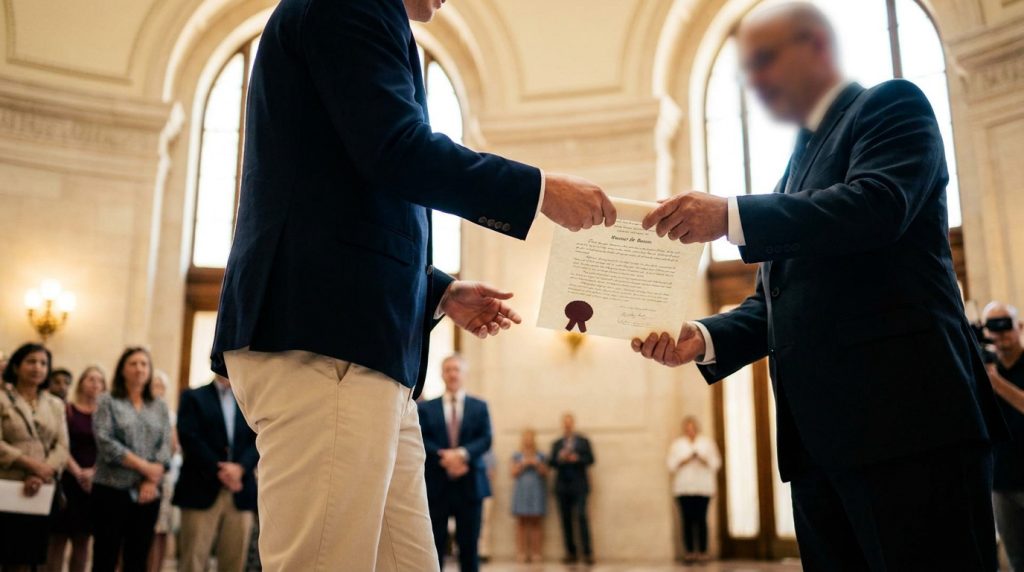
After your naturalisation decree is published, the prefecture (préfecture) invites you to a citizenship welcome ceremony (cérémonie d'accueil dans la citoyenneté française). By law, it must be organised within 6 months following the acquisition of nationality. During the ceremony, you receive the Charter of the Rights and Duties of the French Citizen (charte des droits et devoirs du citoyen français), and generally a copy of your decree and your civil status records (actes d'état civil). Good news: you are already French on the day of the ceremony.
Update: October 2026. Information verified on 10 October 2026 on official websites (sources at the bottom of the page).
Practise for free: 10 corrected questions, no sign-up.
Take the free test (10 questions) →The questions are in French, as in the real exam. The explanations are in your language.
The ceremony in brief
| Who organises it? | The prefect (préfet) (the Prefect of Police in Paris), or the mayor if requested |
|---|---|
| When? | Within 6 months following the acquisition of nationality |
| For whom? | People who became French by naturalisation or by declaration (marriage, family…) |
| What you receive | The Charter of the Rights and Duties of the French Citizen; generally a copy of the decree and your civil status records |
| Guests | The deputies and senators of the department |
| Cost | Free |
What the law says
Article 21-28 of the Civil Code (code civil) provides that the state representative in the department (in Paris, the Prefect of Police) organises a welcome ceremony within a period of 6 months from the acquisition of French nationality. It concerns people who live in the department and who became French, for example by naturalisation or by declaration following a marriage.
- The deputies and senators elected in the department are invited.
- During the ceremony, the Charter of the Rights and Duties of the French Citizen is given to the new French citizens.
- According to Article 21-29, the prefect sends the mayor a list of people in their municipality. If the mayor requests it, they may be authorised to organise the ceremony themselves, at the town hall.
Before the ceremony: the first steps
- The decree is published in the Official Journal (Journal officiel). You receive an email or letter confirming your registration in the decree.
- Download your decree from Légifrance. You need its publication date from the Official Journal. Check that there are no errors in your name, your children's names or your dates.
- Request your French civil status records if you need them quickly: according to Réfugiés.info, you can request them from the Central Civil Status Service (service central d'état civil, SCEC) in Nantes in the first weeks after the decree, without waiting for the ceremony.
- Receive your invitation from the prefecture, approximately 6 months after the decree according to Réfugiés.info.
The day of the ceremony
The exact order depends on each prefecture or town hall. In general, the ceremony is an official and friendly occasion, with speeches from the authorities. What is provided by law:
- the presentation of the Charter of the Rights and Duties of the French Citizen ;
- according to Réfugiés.info, the presentation of a copy of your naturalisation decree (décret de naturalisation) and a copy of your French civil status records (birth certificate, marriage certificate…).
Our practical advice:
- Read your invitation carefully: it shows the location, time and documents to bring.
- Arrive early: there is often a security check at the entrance.
- If you want to come with family or friends, check your invitation to see if this is possible and how many people can come.
- If you cannot come, notify the prefecture as soon as possible.
To review the values and symbols of the Republic before this moment, you can re-read the citizen's handbook.
Your minor children
Your minor children become French with you if they usually live with you and if their name appears in your decree. Check the decree carefully: if a child's name is not there, contact the prefecture quickly.
After the ceremony: your formalities
- Identity card and passport: make your request at the town hall (with an appointment in most municipalities).
- Electoral rolls: check that you are registered on the electoral roll of your municipality.
- Census: if you became French between 16 and 25 years old, register in the month following.
- Keep your decree, your civil status records and the Charter in a safe place.
To discover everything that nationality changes in your life, read our article on the practical benefits of French nationality.
See also: French Nationality Certificate: Purpose and Process
If you do not receive an invitation
By law, a ceremony must be held within 6 months, but actual timescales vary. If you have received nothing after this time, contact the nationality service at your prefecture. In the meantime, the ceremony is not a requirement for being French: you can already request your records from the SCEC in Nantes and prepare your identity documents.
Frequently asked questions
Am I French before the ceremony?
Yes. The law speaks of a ceremony organised after the acquisition of nationality: you are already French on the day of the ceremony.
Is the ceremony compulsory?
The prefect must organise it. For you, it is an important occasion and it is often where you receive your documents. If you cannot come, notify the prefecture.
How long after the decree?
The law provides for a period of 6 months from the acquisition of nationality. According to Réfugiés.info, the invitation arrives approximately 6 months after the decree.
What do I receive during the ceremony?
The Charter of the Rights and Duties of the French Citizen. In general, you also receive a copy of your decree and your French civil status records.
Can I request my birth certificate before the ceremony?
Yes. According to Réfugiés.info, you can request it from the SCEC in Nantes in the first weeks after the decree.
Preparing for the civic exam? Take our free civic test with 10 corrected questions, then a naturalisation mock exam with 40 questions in 45 minutes.
Sources (verified on 10 October 2026): Civil Code, Articles 21-28 and 21-29 (Légifrance, current version); Réfugiés.info (information sheet provided by the Ministry of the Interior), "Demander la nationalité française"; Service-Public.fr, "Naturalisation française par décret" (verified on 16 July 2026). This website is independent and is not a government website.
Get the civic booklet (livret du citoyen) 2026 for free — official PDF — the syllabus of the civic exam (examen civique), sent to your inbox. The document is in French.
Ready to test yourself?
Practise for free with our civic exam (examen civique) simulator, or go further with the complete guide.
Read also
French nationality at 65 for ascendants of French citizens: 2026 rules
Are you 65 or older, with a French child or grandchild? Conditions, documents, cost and deadlines for the ascendant's nationality declaration in 2026.

ANEF naturalization status: tracking your file and understanding it
Track your naturalization file on the ANEF: the official stages, what the statuses mean, the 18-month legal deadline and who to contact if nothing…

Naturalization appeal letter: templates and method (2026)
Naturalization refusal or adjournment: appeal to the Minister within 2 months, where to send it, how to write it, 2 letter templates to adapt.