Document translation for naturalization: birth certificate and translator
By PrepNova Editions · Published on · Updated on

For naturalization, every document written in a foreign language must be translated into French by a certified translator (traducteur agréé). This is the case in particular for your birth certificate. A translation made by yourself or by a relative is not accepted. Here are the documents to translate, the rules for the birth certificate, legalization or apostille, and how to find a certified translator.
Updated: November 2026. Information verified on 17 November 2026 on official websites (sources at the bottom of the page).
Practise for free: 10 corrected questions, no sign-up.
Take the free test (10 questions) →The questions are in French, as in the real exam. The explanations are in your language.
The essentials in brief
| Which documents? | All documents written in a foreign language |
|---|---|
| Who translates? | A certified translator (judicial expert registered with a court of appeal or the Court of Cassation), or a translator authorized in another European country |
| What to provide? | The original translation, together with the original document |
| Birth certificate | Original, as a full copy, in the language of the country of origin |
| Less than 3 months old? | Only for French civil status records |
| No translation needed? | Multilingual extract that includes French (adult applicant); certain European Union documents with a multilingual form |
Which documents must be translated?
The rule is simple: every document written in a foreign language must be accompanied by a French translation. You must provide the original translation, not a photocopy. For a naturalization file, this often includes:
- your birth certificate;
- your marriage certificate, and the birth certificates of your children born abroad;
- divorce judgments or death certificates that prove the end of a previous marriage;
- documents that prove the date and place of birth of your parents;
- your foreign diplomas, if you use them in the file;
- foreign criminal record extracts (casier judiciaire), if they are requested.
For the full list of documents, use our naturalization file checklist.
The foreign birth certificate: the rules
- Provide the certificate in original and as a full copy (copie intégrale), in the language of the country of origin. A simple summary is not enough.
- The certificate must state the names, first names, date and place of birth of your parents. If one of these details is missing, the administration may ask you for your parents' birth certificates.
- If the certificate was drawn up, corrected or amended by a court judgment, add a copy of that judgment.
- The 3-month rule applies only to French civil status records: a French record must have been issued less than 3 months ago. It does not apply to your foreign birth certificate.
Ask for your certificate from the civil registry officer where it is kept, or from the consulate of your country in France. If you cannot obtain your birth certificate, the administration will ask you for other documents.
Cases where a translation is not needed
- Multilingual extract (extrait plurilingue): if your birth or marriage certificate is a multilingual extract with French as one of its languages, no translation is needed for an adult applicant.
- European Union documents: for certain public documents issued in a European Union country, you can attach a multilingual form instead of a translation. Ask the authority that issued the document for it. The French administration may still ask for a translation if necessary.
Legalization or apostille
Some documents issued abroad must be legalized (légalisation) or carry an apostille (apostille) to be accepted in France. These formalities verify the origin and the signature of the document, but not its content.
- For legalization, check with the French embassy or consulate in the country that issued the document.
- For the apostille, check with the embassy or consulate of that country.
It is advisable to complete this formality before the translation, so that the translator also translates the legalization or apostille. The rules vary by country: some countries are exempt under agreements with France.
How to find a certified translator
A certified translator is a judicial expert registered on the lists of the courts of appeal or on the national list of the Court of Cassation. The term « sworn translator » is also used.
- In France: use the online service « Find a certified expert or a certified translator » on Service-Public.fr. You can also check the website of the consulate in France of the country that issued the document.
- Abroad: the list of translators approved by the local authorities is often on the website of the French consulate. The translator's signature must then be certified by the consulate.
- In another European country: a translation made by a translator authorized by the judicial or administrative authorities of that country is accepted.
The price is not set by law: it depends on the language, the document and the translator. Ask several translators for a quote before you choose.
Mistakes that delay the file
- sending a photocopy of the translation instead of the original;
- having a document translated by a translator who is not certified;
- sending an extract of the birth certificate instead of a full copy;
- forgetting to have the legalization or apostille translated;
- believing that a foreign document must be less than 3 months old, and paying for unnecessary procedures.
The file is then submitted online: read our guide on the online naturalization file. Do not forget either the certificate of success in the civics exam (examen civique), which is mandatory for naturalization by decree.
Frequently asked questions
Does my foreign birth certificate have to be less than 3 months old?
No. The 3-month rule applies to French civil status records. For your foreign certificate, provide the original as a full copy, with its translation.
Can I translate my documents myself?
No. The translation must be made by a certified translator, or by a translator authorized in another European country.
Are a certified translator and a sworn translator the same thing?
Yes, in everyday language. It is a translator registered as a judicial expert with a court of appeal or the Court of Cassation.
My certificate is multilingual. Do I have to have it translated?
No, if French is one of the languages of the extract and you are an adult.
Sources (verified on 17 November 2026): Service-Public.fr, « Naturalisation française par décret » (verified on 16 July 2026); Service-Public.fr, « Traduction d'un document : comment trouver un traducteur agréé ? » (verified on 26 January 2026); Service-Public.fr, « Légalisation d'un acte public établi par une autorité étrangère ». This website is independent and is not a government website.
Get the civic booklet (livret du citoyen) 2026 for free — official PDF — the syllabus of the civic exam (examen civique), sent to your inbox. The document is in French.
Ready to test yourself?
Practise for free with our civic exam (examen civique) simulator, or go further with the complete guide.
Read also
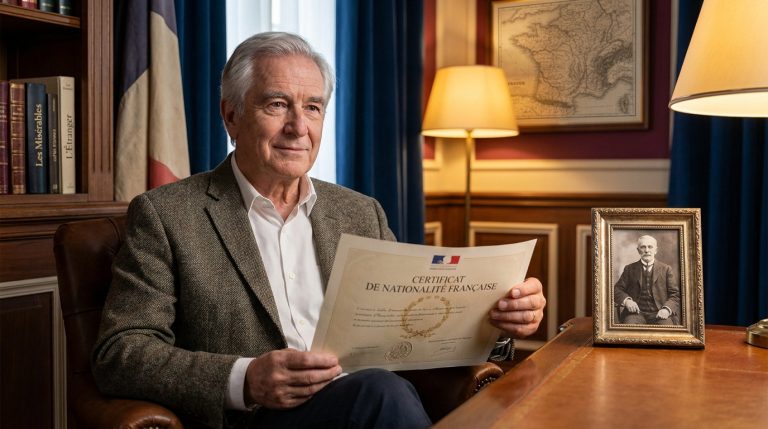
French nationality at 65 for ascendants of French citizens: 2026 rules
Are you 65 or older, with a French child or grandchild? Conditions, documents, cost and deadlines for the ascendant's nationality declaration in 2026.

ANEF naturalization status: tracking your file and understanding it
Track your naturalization file on the ANEF: the official stages, what the statuses mean, the 18-month legal deadline and who to contact if nothing…

Naturalization appeal letter: templates and method (2026)
Naturalization refusal or adjournment: appeal to the Minister within 2 months, where to send it, how to write it, 2 letter templates to adapt.